
Boiler Repair Oxford: Should the Existing Fault Be Diagnosed Before You Plan a Replacement?
When an older boiler develops a fault, it can be tempting to start looking for a replacement immediately. However, a breakdown does not always mean that the appliance has reached the end of its useful life.

Why you can trust our content
We understand that the boiler industry can be confusing, with plenty of outdated or misleading information. That’s why we rely only on trusted, proven sources to guide our advice and installations:

At a glance
A proper diagnosis can provide valuable information before you decide whether to repair the boiler or plan an upgrade. The nature of the fault, the age and condition of the appliance, availability of parts and likely future reliability can all influence the sensible next step.
For homeowners considering boiler repair oxford, understanding the fault first can help prevent an unnecessary replacement and provide a clearer basis for planning one if replacement is ultimately appropriate.
Why should a boiler fault be diagnosed before planning a replacement?
The symptoms of a boiler problem do not always identify the underlying cause.
A boiler that repeatedly loses pressure, fails to provide hot water or switches itself off could have several possible causes. Some may be relatively straightforward to address, while others could indicate deterioration of a major component.
A professional diagnosis helps establish what is actually happening rather than assuming that the appliance itself has failed.
This matters when deciding between boiler repair and replacement because the apparent symptom may not tell you whether an economical repair is possible.
If your boiler is showing unusual symptoms, JA Plumbing And Heating Solutions Ltd can assess the problem and provide practical guidance on the available options.
What should an engineer check when diagnosing a boiler fault?
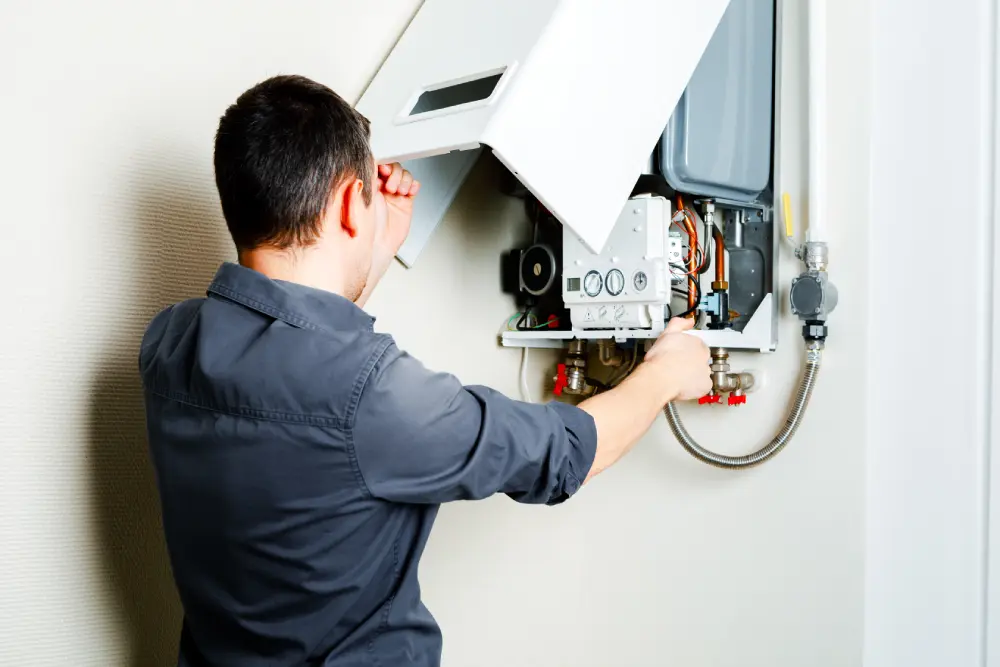
The exact checks depend on the symptoms, boiler type and fault displayed, but an engineer will generally investigate the appliance and relevant parts of the heating system.
The assessment may consider:
- Fault codes or warning indicators
- Boiler pressure
- Ignition and burner operation
- Heating and hot water performance
- Circulation
- Electrical components
- Pumps and valves
- Thermostats and controls
- Visible leaks or signs of corrosion
- Flue and ventilation arrangements
- Relevant pipework and connections
The objective is to identify the cause of the problem and determine whether the appliance can be safely operated.
Let’s get started, Which fuel powers your boiler?
It just takes 60 Sec
And then you can book a free consultation
Does the age of the boiler matter?
Yes, although age alone does not determine whether a boiler should be replaced.
An older appliance may still be repairable, particularly if the fault is relatively minor and suitable replacement parts are available. However, repeated failures or deterioration of several components can change the calculation.
When assessing boiler repair oxford homeowners should consider the bigger picture rather than looking only at the immediate fault.
Useful questions include:
- How old is the boiler?
- Has it required several repairs recently?
- Are replacement parts readily available?
- Is the boiler operating reliably when repaired?
- Is the current heating system meeting household needs?
- Are there signs of wider deterioration?
- How much would the proposed repair cost?
A diagnosis gives you information with which to answer these questions.
What types of boiler faults might require closer investigation?
Some problems can have several possible causes.
Loss of pressure
Low boiler pressure can sometimes be related to a straightforward issue, but repeated pressure loss may indicate a leak or another underlying problem that needs investigation.
No heating or hot water
This symptom can be caused by different components or system conditions. The correct diagnosis is therefore more useful than replacing parts without establishing the cause.
Unusual noises
Banging, kettling, whistling or humming noises can have different explanations. An engineer should investigate the source rather than assuming that the boiler needs replacing.
Repeated shutdowns
A boiler that frequently locks out may be responding to a fault condition. The reason for the shutdown needs to be established before deciding what action to take.
Leaks
Water around the boiler or associated pipework should not simply be ignored. The source and seriousness of the leak need to be assessed.
How can a diagnosis help with replacement planning?
A diagnosis can tell you more than whether the immediate fault can be repaired.
It can provide insight into the overall condition of the appliance. If the boiler has developed one fault but the engineer also identifies significant deterioration elsewhere, that information may be relevant when considering whether to continue repairing it.
Conversely, if the issue is isolated and the rest of the appliance appears to be in reasonable condition, repair may remain a practical option.
The decision should be based on the specific circumstances rather than a blanket rule about boiler age.
Repair or replacement: what information should you compare?
There is no single answer that applies to every household. Instead, compare the immediate repair with the wider implications of continuing to operate an ageing appliance.
| Factor | Repair | Replacement |
| Immediate expenditure | Usually focused on the identified fault | Higher initial project cost |
| Boiler age | Existing appliance remains | New appliance installed |
| Parts availability | Important for older models | New components supplied |
| Reliability | Depends on overall appliance condition | New system may provide a fresh starting point |
| Efficiency | Existing appliance remains | Modern condensing boiler may offer different performance |
| Future repairs | Potentially more repairs over time | Warranty may cover certain components or work |
| Installation work | Usually limited to the fault | Requires planned removal and installation |
This table is a planning aid rather than a recommendation. The right choice depends on the condition of the appliance, the nature of the fault and the homeowner’s circumstances.
When might repair make sense?
Repair can be worth considering when the fault is clearly identified, the appliance is otherwise in reasonable condition and the required work is proportionate.
For example, a relatively straightforward component failure on a boiler that has otherwise operated reliably may not justify replacing the entire system.
The engineer should explain the diagnosis and proposed repair so the homeowner understands what is being addressed.
It is also worth considering whether the boiler has a history of similar failures. A single isolated problem can be very different from a pattern of repeated breakdowns.
When should you start discussing replacement?
Replacement planning may become relevant when repairs are becoming frequent, parts are difficult to source, or the boiler has deteriorated significantly.
It can also make sense to start planning ahead when the appliance is no longer meeting the household’s needs.
For example, a homeowner may have extended the property, changed how rooms are used or experienced increasing hot water demand. Even if the existing boiler can still be repaired, its suitability for the property may be worth reviewing.
If you are unsure whether another repair is worthwhile, contact JA Plumbing And Heating Solutions Ltd for an assessment and advice based on the condition of your existing system.
What if the boiler breaks down while you are considering replacement?
You do not necessarily have to make a rushed replacement decision.
If the boiler can be safely diagnosed and repaired, a temporary repair may give you time to research replacement options properly. This can be particularly useful if you need to compare boiler types, installation arrangements and quotations.
However, if the appliance is unsafe or cannot be operated safely, it should remain switched off until the appropriate professional assessment has taken place.
Safety should always take priority over keeping an ageing boiler running for a little longer.
A typical Oxford homeowner scenario
Imagine a homeowner whose older boiler suddenly stops providing hot water. They initially assume it needs replacing and begin looking at replacement options.
An engineer investigates and finds that the immediate problem is linked to a failed component. The rest of the appliance is assessed and does not show obvious signs of major deterioration.
The homeowner can now make a more informed choice. They may decide to repair the boiler and begin planning a future replacement, rather than having to arrange an immediate upgrade without knowing what caused the failure.
This approach can provide useful breathing space while still addressing the immediate heating problem.
How should you plan a future boiler replacement?
If the diagnosis suggests that replacement is likely to be the sensible long-term option, there is value in planning before the existing appliance fails completely.
You can use this opportunity to:
- Arrange a home survey
- Review the current heating system
- Consider whether a combi, system or regular boiler is appropriate
- Discuss potential boiler locations
- Check whether controls need updating
- Understand likely installation requirements
- Obtain a detailed quotation
- Plan the installation around your household’s needs
Planning ahead can be particularly useful with an older boiler because you can make decisions calmly rather than responding to a complete breakdown.
Conclusion: Look beyond the boiler price
A boiler fault does not automatically mean that replacement is the only option. Diagnosing the underlying problem provides useful information about the immediate repair and the overall condition of the appliance.
For some homeowners, a straightforward repair may be enough to restore reliable heating. For others, repeated faults, ageing components or wider system issues may make replacement planning more appropriate.
The important point is to base the decision on the actual condition of the boiler rather than assumptions. JA Plumbing And Heating Solutions Ltd can help assess the problem, explain the available options and support you in planning the next step.
Contact our team if you need a boiler assessment, repair advice or guidance on planning a replacement in Oxford.
Related articles


Let’s get started, Which fuel powers your boiler?
At a glance
A proper diagnosis can provide valuable information before you decide whether to repair the boiler or plan an upgrade. The nature of the fault, the age and condition of the appliance, availability of parts and likely future reliability can all influence the sensible next step.
For homeowners considering boiler repair oxford, understanding the fault first can help prevent an unnecessary replacement and provide a clearer basis for planning one if replacement is ultimately appropriate.
Why should a boiler fault be diagnosed before planning a replacement?
The symptoms of a boiler problem do not always identify the underlying cause.
A boiler that repeatedly loses pressure, fails to provide hot water or switches itself off could have several possible causes. Some may be relatively straightforward to address, while others could indicate deterioration of a major component.
A professional diagnosis helps establish what is actually happening rather than assuming that the appliance itself has failed.
This matters when deciding between boiler repair and replacement because the apparent symptom may not tell you whether an economical repair is possible.
If your boiler is showing unusual symptoms, JA Plumbing And Heating Solutions Ltd can assess the problem and provide practical guidance on the available options.
What should an engineer check when diagnosing a boiler fault?
The exact checks depend on the symptoms, boiler type and fault displayed, but an engineer will generally investigate the appliance and relevant parts of the heating system.
The assessment may consider:
- Fault codes or warning indicators
- Boiler pressure
- Ignition and burner operation
- Heating and hot water performance
- Circulation
- Electrical components
- Pumps and valves
- Thermostats and controls
- Visible leaks or signs of corrosion
- Flue and ventilation arrangements
- Relevant pipework and connections
The objective is to identify the cause of the problem and determine whether the appliance can be safely operated.
Let’s get started, Which fuel powers your boiler?
It just takes 60 Sec
And then you can book a free consultation
Does the age of the boiler matter?
Yes, although age alone does not determine whether a boiler should be replaced.
An older appliance may still be repairable, particularly if the fault is relatively minor and suitable replacement parts are available. However, repeated failures or deterioration of several components can change the calculation.
When assessing boiler repair oxford homeowners should consider the bigger picture rather than looking only at the immediate fault.
Useful questions include:
- How old is the boiler?
- Has it required several repairs recently?
- Are replacement parts readily available?
- Is the boiler operating reliably when repaired?
- Is the current heating system meeting household needs?
- Are there signs of wider deterioration?
- How much would the proposed repair cost?
A diagnosis gives you information with which to answer these questions.
What types of boiler faults might require closer investigation?
Some problems can have several possible causes.
Loss of pressure
Low boiler pressure can sometimes be related to a straightforward issue, but repeated pressure loss may indicate a leak or another underlying problem that needs investigation.
No heating or hot water
This symptom can be caused by different components or system conditions. The correct diagnosis is therefore more useful than replacing parts without establishing the cause.
Unusual noises
Banging, kettling, whistling or humming noises can have different explanations. An engineer should investigate the source rather than assuming that the boiler needs replacing.
Repeated shutdowns
A boiler that frequently locks out may be responding to a fault condition. The reason for the shutdown needs to be established before deciding what action to take.
Leaks
Water around the boiler or associated pipework should not simply be ignored. The source and seriousness of the leak need to be assessed.
How can a diagnosis help with replacement planning?
A diagnosis can tell you more than whether the immediate fault can be repaired.
It can provide insight into the overall condition of the appliance. If the boiler has developed one fault but the engineer also identifies significant deterioration elsewhere, that information may be relevant when considering whether to continue repairing it.
Conversely, if the issue is isolated and the rest of the appliance appears to be in reasonable condition, repair may remain a practical option.
The decision should be based on the specific circumstances rather than a blanket rule about boiler age.
Repair or replacement: what information should you compare?
There is no single answer that applies to every household. Instead, compare the immediate repair with the wider implications of continuing to operate an ageing appliance.
| Factor | Repair | Replacement |
| Immediate expenditure | Usually focused on the identified fault | Higher initial project cost |
| Boiler age | Existing appliance remains | New appliance installed |
| Parts availability | Important for older models | New components supplied |
| Reliability | Depends on overall appliance condition | New system may provide a fresh starting point |
| Efficiency | Existing appliance remains | Modern condensing boiler may offer different performance |
| Future repairs | Potentially more repairs over time | Warranty may cover certain components or work |
| Installation work | Usually limited to the fault | Requires planned removal and installation |
This table is a planning aid rather than a recommendation. The right choice depends on the condition of the appliance, the nature of the fault and the homeowner’s circumstances.
When might repair make sense?
Repair can be worth considering when the fault is clearly identified, the appliance is otherwise in reasonable condition and the required work is proportionate.
For example, a relatively straightforward component failure on a boiler that has otherwise operated reliably may not justify replacing the entire system.
The engineer should explain the diagnosis and proposed repair so the homeowner understands what is being addressed.
It is also worth considering whether the boiler has a history of similar failures. A single isolated problem can be very different from a pattern of repeated breakdowns.
When should you start discussing replacement?
Replacement planning may become relevant when repairs are becoming frequent, parts are difficult to source, or the boiler has deteriorated significantly.
It can also make sense to start planning ahead when the appliance is no longer meeting the household’s needs.
For example, a homeowner may have extended the property, changed how rooms are used or experienced increasing hot water demand. Even if the existing boiler can still be repaired, its suitability for the property may be worth reviewing.
If you are unsure whether another repair is worthwhile, contact JA Plumbing And Heating Solutions Ltd for an assessment and advice based on the condition of your existing system.
What if the boiler breaks down while you are considering replacement?
You do not necessarily have to make a rushed replacement decision.
If the boiler can be safely diagnosed and repaired, a temporary repair may give you time to research replacement options properly. This can be particularly useful if you need to compare boiler types, installation arrangements and quotations.
However, if the appliance is unsafe or cannot be operated safely, it should remain switched off until the appropriate professional assessment has taken place.
Safety should always take priority over keeping an ageing boiler running for a little longer.
A typical Oxford homeowner scenario
Imagine a homeowner whose older boiler suddenly stops providing hot water. They initially assume it needs replacing and begin looking at replacement options.
An engineer investigates and finds that the immediate problem is linked to a failed component. The rest of the appliance is assessed and does not show obvious signs of major deterioration.
The homeowner can now make a more informed choice. They may decide to repair the boiler and begin planning a future replacement, rather than having to arrange an immediate upgrade without knowing what caused the failure.
This approach can provide useful breathing space while still addressing the immediate heating problem.
How should you plan a future boiler replacement?
If the diagnosis suggests that replacement is likely to be the sensible long-term option, there is value in planning before the existing appliance fails completely.
You can use this opportunity to:
- Arrange a home survey
- Review the current heating system
- Consider whether a combi, system or regular boiler is appropriate
- Discuss potential boiler locations
- Check whether controls need updating
- Understand likely installation requirements
- Obtain a detailed quotation
- Plan the installation around your household’s needs
Planning ahead can be particularly useful with an older boiler because you can make decisions calmly rather than responding to a complete breakdown.
Conclusion: Look beyond the boiler price
A boiler fault does not automatically mean that replacement is the only option. Diagnosing the underlying problem provides useful information about the immediate repair and the overall condition of the appliance.
For some homeowners, a straightforward repair may be enough to restore reliable heating. For others, repeated faults, ageing components or wider system issues may make replacement planning more appropriate.
The important point is to base the decision on the actual condition of the boiler rather than assumptions. JA Plumbing And Heating Solutions Ltd can help assess the problem, explain the available options and support you in planning the next step.
Contact our team if you need a boiler assessment, repair advice or guidance on planning a replacement in Oxford.